
LAN
LAN

Regulations
US FDA 510k Clearance Consulting for Medical Devices & IVDs
US FDA 510k Clearance Consulting for Medical Devices & IVDs
US FDA 510k Clearance Consulting for Medical Devices & IVDs
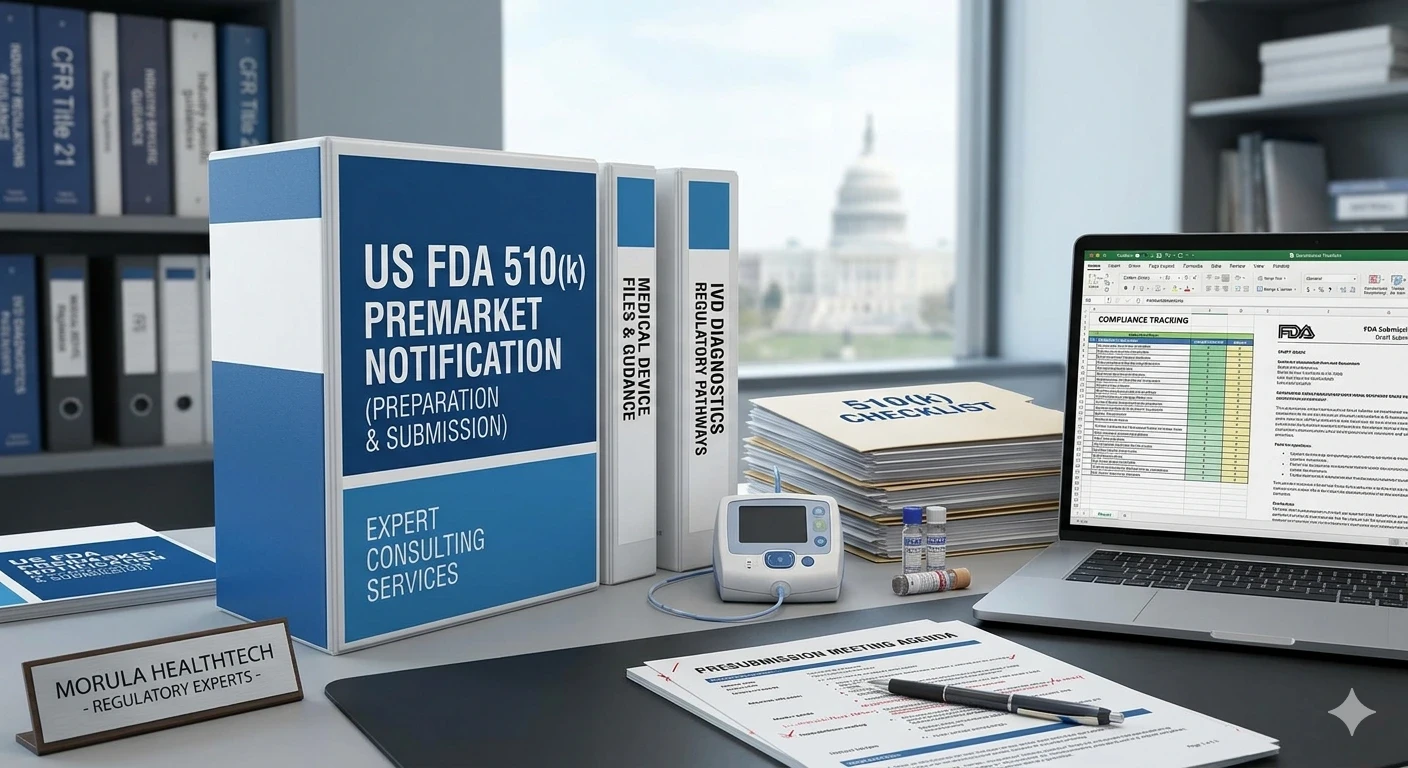
Historically many medical device manufacturers started in Europe first.. Now things are changing fast. With the EU MDR and IVDR being rolled out many manufacturers are focusing on the United States. The companies want to get FDA 510k Clearance so they can sell their products in Europe without waiting long. They have high standards for safety and performance. Even though the rules are tough, the process of getting a 510k Clearance is often easier to follow and faster than in other countries. This gives people who use these devices and the doctors who prescribe them confidence that they are safe. The FDA 510k Clearance is important for medical devices to be approved in the United States and it helps companies get their products to the market faster.
At Morulaa Health Tech the FDA 510k consultants at Morulaa Health Tech work with you like they are part of your team. They help you with the FDA medical device registration and compliance in a way that's easy on your budget. The FDA 510k consultants at Morulaa Health Tech take care of everything from the paperwork and technical checks to what happens after the product is on the market like reporting bad side effects to the FDA. The team at Morulaa Health Tech does all the steps for FDA 510k Clearance so you can get it done quickly, spend less money and follow all the rules.
The 4-Step FDA 510k Clearance & Registration Process
Our FDA 510k consultants guide you through every phase of the FDA 510k Clearance journey:
Step 1: Determining Your Device Class for FDA 510k Clearance
To begin, you must determine where your product fits within the FDA’s three-tier risk-based classification system. This is a critical first step, as the device’s class dictates the specific regulatory requirements, the amount of data needed for submission, and the overall cost of bringing the product to market.
Class I: These are low-risk products (like bandages or sunglasses) that are mostly exempt from premarket review and only need to follow basic "General Controls" for labeling and manufacturing.
Class II: Moderate-risk products (like syringes or powered wheelchairs) requiring a 510(k) submission to demonstrate Substantial Equivalence (SE) to a to a device already on the market.
Class III: These are high-risk or life-sustaining products (like pacemakers or heart valves) that require Premarket Approval (PMA), which involves rigorous clinical data to prove safety and effectiveness.
Step 2: Execute the Correct 510k Submission Strategy
The regulatory route you choose affects testing, submission process and approval timeline.
For moderate-risk devices a 510k submission is required. You must show that your device is similar to a device on the market. The FDA usually takes 90 days to review these submissions but it can take longer if they have questions. We can help you streamline the documentation process a smooth FDA 510k Clearance.
For Class III or life-sustaining devices, a Premarket Approval (PMA) is mandatory. A PMA differs from the 510(k) process in one key way: it does not rely on equivalence to a similar device. Instead, you must independently demonstrate a "reasonable assurance of safety and effectiveness" through a series of clinical evidence and human trial data.
Post-Market Compliance: Once you’ve secured FDA 510k Clearance, the focus shifts from entry to endurance. We provide end-to-end support for post-market compliance, like managing FDA adverse event reporting to ensure your device remains safe for the public and legally compliant. Our goal is to handle the heavy lifting of surveillance so your product stays on the market without interruption.
Step 3: Establishment Registration and FDA 510k Clearance Listing
Establishment registration enrolls your firm in the FDA 's database, while device listing informs the FDA specifically which products you are selling. Getting this done early ideally right after your 510k submission is cleared prevents major compliance problems later.
Who Must Register: Device manufacturers (US or foreign), contract manufacturers, sterilization services, repackagers, reprocessors, and importers/exporters.
The Process: This process is completed online using the FDA 's Unified Registration and Listing System (FURLS). As your FDA 510k submission consultants, we confirm your registration is accurate and linked to the correct pre-market submission numbers.
Compliance: When you register you have to follow the rules of the FDA medical device reporting. This means you have to tell the FDA about any problems with your devices or if they do not work right. You have to do this reporting on the computer.If you work with someone who knows a lot about FDA 510k you can be sure that you pay your fees every year and that your list of devices is always current. This helps you to be able to sell your devices in the US without any problems.
Step 4: Maintaining Compliance through QMSR and FDA medical device reporting
After your device is being sold you have to keep watching to make sure it is safe and good quality and that you are following all the rules.
21 CFR Part 820 (QMSR): This is a rule about Quality Management System Regulation. Most people who make devices have to follow this rule. If you make Class II or Class III devices you have to follow all of the rules, which include designing and making your devices in a way and taking actions to fix any problems. Some devices that are not very risky, like some Class I devices do not have to follow all of the rules. They still have to follow some basic ideas.
Regulatory Reporting: You must monitor the way the device operates in the real world and immediately report any adverse events or malfunctions to the FDA . Our team assists you in establishing systems for both routine FDA medical device reporting and critical FDA adverse event reporting to confirm complete compliance.
Frequently Asked Questions (FAQ)
Historically many medical device manufacturers started in Europe first.. Now things are changing fast. With the EU MDR and IVDR being rolled out many manufacturers are focusing on the United States. The companies want to get FDA 510k Clearance so they can sell their products in Europe without waiting long. They have high standards for safety and performance. Even though the rules are tough, the process of getting a 510k Clearance is often easier to follow and faster than in other countries. This gives people who use these devices and the doctors who prescribe them confidence that they are safe. The FDA 510k Clearance is important for medical devices to be approved in the United States and it helps companies get their products to the market faster.
At Morulaa Health Tech the FDA 510k consultants at Morulaa Health Tech work with you like they are part of your team. They help you with the FDA medical device registration and compliance in a way that's easy on your budget. The FDA 510k consultants at Morulaa Health Tech take care of everything from the paperwork and technical checks to what happens after the product is on the market like reporting bad side effects to the FDA. The team at Morulaa Health Tech does all the steps for FDA 510k Clearance so you can get it done quickly, spend less money and follow all the rules.
The 4-Step FDA 510k Clearance & Registration Process
Our FDA 510k consultants guide you through every phase of the FDA 510k Clearance journey:
Step 1: Determining Your Device Class for FDA 510k Clearance
To get started you need to find out where your product fits in the FDAs system that has three levels of risk. This is really important because it determines how information you will have to give them. The FDA has three classes of products.
Class I products are risky like tongue depressors or tools that doctors use to do surgery by hand. These things are pretty simple. Do not need a lot of paperwork.
Class II products are at a risk like machines that give people medicine or special sheets that doctors use when they do surgery. Most of the time you have to do a 510k submission to show that these things are safe and work well.
Class III products are things like heart valves or pacemakers that help keep people alive. The Food and Drug Administration takes a close look at these Class III products. They want to make sure these Class III products are safe for people to use and that they work the way these Class III products should. This is why these Class III products have to go through a tough review process to get approved.
Step 2: Execute the Correct 510k Submission Strategy
The regulatory route you choose affects testing, submission process and approval timeline.
For moderate-risk devices a 510k submission is required. You must show that your device is similar to a device on the market. The FDA usually takes 90 days to review these submissions but it can take longer if they have questions. Our experts help prepare the documents for FDA 510k Clearance.
For high-risk devices a PMA submission is needed, which includes results from trials.
Post-Market Compliance: After getting FDA 510k Clearance we help with requirements, such as reporting adverse events, to the FDA to ensure your device remains safe for users. This helps confirm your device is safe to stay on the market. We assist with FDA adverse event reporting. The goal is to keep your device on the market.
Step 3: Establishment Registration and FDA 510k Clearance Listing
Establishment registration enrolls your firm in the FDA 's database, while device listing informs the FDA specifically which products you are selling. Getting this done early ideally right after your 510k submission is cleared prevents major compliance problems later.
Who Must Register: Device manufacturers (US or foreign), contract manufacturers, sterilization services, repackagers, reprocessors, and importers/exporters.
The Process: This process is completed online using the FDA 's Unified Registration and Listing System (FURLS). As your FDA 510k submission consultants, we confirm your registration is accurate and linked to the correct pre-market submission numbers.
Compliance: When you register you have to follow the rules of the FDA medical device reporting. This means you have to tell the FDA about any problems with your devices or if they do not work right. You have to do this reporting on the computer. If you work with someone who knows a lot about FDA 510k you can be sure that you pay your fees every year and that your list of devices is always current. This helps you to be able to sell your devices in the US without any problems.
Step 4: Maintaining Compliance through QMSR and FDA medical device reporting
After your device is being sold you have to keep watching to make sure it is safe and good quality and that you are following all the rules.
21 CFR Part 820 (QMSR): This is a rule about Quality Management System Regulation. Most people who make devices have to follow this rule. If you make Class II or Class III devices you have to follow all of the rules, which include designing and making your devices in a way and taking actions to fix any problems. Some devices that are not very risky, like some Class I devices do not have to follow all of the rules. They still have to follow some basic ideas.
Regulatory Reporting: You must monitor the way the device operates in the real world and immediately report any adverse events or malfunctions to the FDA . Our team assists you in establishing systems for both routine FDA medical device reporting and critical FDA adverse event reporting to confirm complete compliance.
Who is required to complete the FDA Establishment Registration?
Registration is mandatory for any domestic or foreign facility involved in making, labeling, or repackaging medical devices for the U.S. market. This includes primary manufacturers, contract developers, sterilization services, and initial importers. Completing your FDA Establishment Registration is a legal requirement to ensure every link in your supply chain is visible to the agency.
What is the time frame for getting FDA 510 k Clearance?
The FDA usually looks at a 510k submission for devices that're not too risky in about 90 days.. Sometimes the FDA needs more information and that can take longer. If you work with people who have experience, with 510k submissions you can avoid some of these delays. Get your FDA 510 k Clearance faster.
Do Class I medical devices need to follow all the rules of QMSR compliance?
Class I medical devices typically have to follow the rules that are stated in 21 CFR Part 820. Some Class I medical devices do not have to follow every QMSR rule if they are not very risky and are controlled in a pretty basic way.Class II medical devices and Class III medical devices have to follow all the rules, including the rules, for designing Class II devices and Class III medical devices and making Class II medical devices and Class III medical devices.
How do we maintain compliance after FDA clearance?
Once cleared, you must actively monitor your device’s real-world performance and safety. If any technical glitches or safety issues occur, you are legally required to notify the agency through FDA adverse event reporting. We help you set up these tracking systems to ensure all malfunctions are documented and reported correctly to maintain your standing.
FDA 510 Consultant
FDA Medical Device Reporting
FDA 510K Clearance