
LAN

LAN
Regulations
Latin America (LATAM) ANVISA Medical Device Registration Consulting
Latin America (LATAM) ANVISA Medical Device Registration Consulting
Latin America (LATAM) ANVISA Medical Device Registration Consulting
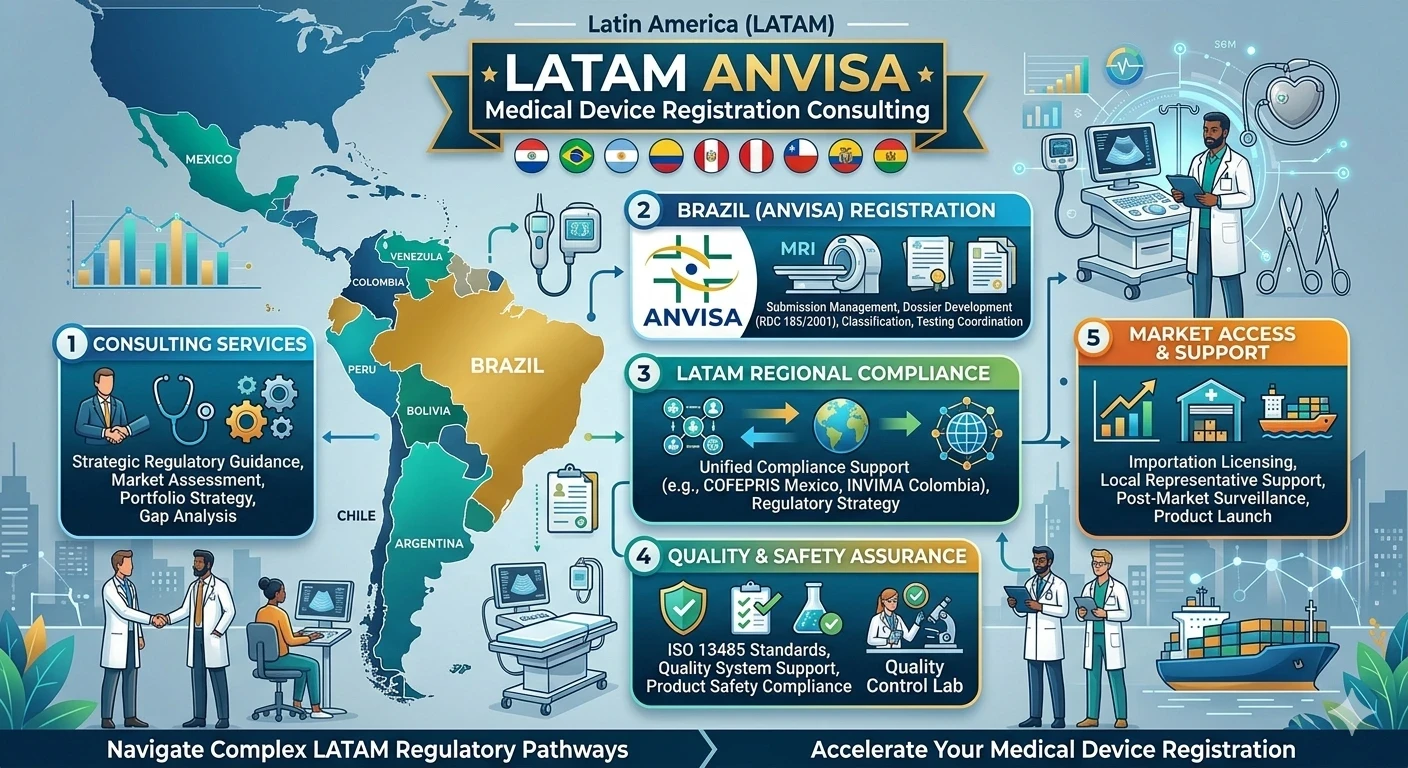
Latin America, also known as LATAM has a lot to offer when it comes to devices. If you want to sell your devices in Latin America you can make a lot of money.. Latin America is not one big group with the same rules. Each country has its rules and its own Ministry of Health. They also speak languages, like Spanish and Portuguese.To sell your devices in these countries you need to follow their rules. For example you need to register your devices with agencies like ANVISA medical device registration in Brazil COFEPRIS in Mexico INVIMA in Colombia and ANMAT in Argentina. This can be very hard to do if you do not have a plan. If you try to register your devices in all these countries without a plan you might have a lot of problems and delays.
You also need to know about the rules in each country. For example in Brazil you need to know about the RDC 848/2024 standards. If you do not follow these rules you might not be able to sell your devices in Brazil. It is very important to stay up-to-date with the rules in Latin America especially, in Brazil if you want to keep selling your medical devices there. Latin America medical device registration is a process and LATAM medical device registration requires a lot of work.
At Morulaa Health Tech, we serve as your unified regulatory partner for Latin America. We prepare your technical dossiers, coordinate closely with your chosen local entities, and manage your product lifecycles across the entire region to ensure seamless compliance.
Comprehensive LATAM ANVISA Medical Device Registration Services by Country
We provide localized expertise and technical documentation support tailored to the specific legal frameworks of your target markets.
Navigating Brazil Medical Device Regulations and Compliance
Brazil medical device regulations are very strict. The National Health Surveillance Agency controls them. To get ANVISA medical device registration you need to appoint a Registration Holder. You also need to translate all documentation into Portuguese.
Here are the timelines for Brazil medical device registration:
Class I and II devices take 30 to 90 days.
Class III and IV devices take 250 days.
The government fees are as follows:
Class I and II fees range from 1,500 to 3,000 BRL.
Class III and IV fees can be, than 49,000 BRL.
To meet Brazil medical device regulations manufacturers need to get a GMP certificate.. They can use their MDSAP scope. According to RDC 848/2024 you must also keep an eye on techno vigilance. This means reporting public health threats or injuries within 72 hours to keep your ANVISA medical device registration. Brazil medical device regulations require you to follow these rules. You must also maintain your ANVISA medical device registration.
Mexico Medical Device Registration
Mexico medical device registration is something that the Federal Commission for the Protection against Sanitary Risk takes seriously. To get a Mexico medical device registration from COFEPRIS you need a thing. You need a sanitary license, a person in Mexico who's responsible for the device and all your documents have to be translated into Spanish.
The time it takes to get a Mexico medical device registration can vary. For devices that're not very risky, like Class I it usually takes about 30 business days. For devices that're a bit riskier like Class II it takes about 35 business days.. For devices that are the riskiest, like Class III it can take up to 60 business days.
The cost of getting a Mexico medical device registration also depends on how risky the device's. For Class I devices it costs $12,188. For Class II devices it costs $17,876.. For Class III devices it costs around $22,752.
If something goes wrong with a Mexico device like someone gets seriously hurt or dies COFEPRIS needs to know right away. There is a rule that says you have to report any problems, within 10 days. This is so COFEPRIS can help keep people safe and figure out what happened with the Mexico device.
Colombia Medical Device Registration
For Colombia medical device registration, the market is overseen by the National Food and Drug Surveillance Institute. A successful INVIMA registration requires a mandated local agent, a Free Sale Certificate (FSC), and technical files in Spanish.
Timelines: Colombia offers rapid access for lower-risk products, processing Class I and IIa devices in just 2-4 days. Class IIb and III devices undergo a 4-6 month review.
Government Fees: Highly accessible fees ranging from USD 750 (Class I/IIa) to USD 850 (Class IIb/III).
The people at INVIMA are very careful. They make sure to report public health threats and bad injuries that can be fatal very quickly. INVIMA has to do this within twenty four hours. This is what INVIMA does to keep everyone from serious public health threats and fatal or serious injury events. INVIMA is always watching out for public health threats.
Argentina Medical Device Registration
Argentina medical device registration is a lot of work because you have to follow the rules of the National Administration of Drugs, Foods and Medical Devices. To register a device with ANMAT you need to have a local sponsor. All your documents have to be in Spanish and it is very important to have ISO 13485 certification.
The time it takes to get a device registered in Argentina is different for each class. For Class I devices it takes thirty to sixty days. For Class II devices it takes ninety to one hundred and twenty days. Class III medical devices take one hundred and twenty to one hundred and eighty days.. For Class IV medical devices it can take one hundred and eighty to three hundred and sixty-five days.
You also have to pay fees to the government. For Class I and Class II devices the fees are between one thousand five hundred dollars and four thousand dollars. For Class III and Class IV medical devices the fees are between four thousand dollars and ten thousand dollars.
If something bad happens with a device like someone gets seriously hurt you have to report it right away. You have to tell the authorities within seventy-two hours if there is a threat or a serious injury related to a medical device. This is called vigilance. It is a very important part of Argentina medical device registration.
Costa Rica Medical Device Registration
Getting medical devices registered in Costa Rica is something that the Ministry of Health takes care of.To do this companies that make these devices in countries need to find someone in Costa Rica who can represent them and handle the registration.
They also need to give some documents like a certificate that says the device can be sold in countries and some instructions on how to use it all written in Spanish.
Costa Rica medical device registration can take a time usually around six to eight months but Costa Rica medical device registration can be faster for devices that are already approved in the United States.
For example if a device has a clearance called US FDA 510(k) or something called Premarket Approval then the process for Costa Rica medical device registration is shorter.
Puerto Rico Medical Device Registration
Because Puerto Rico is an unincorporated territory of the United States, Puerto Rico medical device registration relies on strict adherence to US federal laws.
FDA Compliance: All medical devices have to meet US FDA standards. For example they need 510k, PMA device listing and establishment registration.
Local Oversight: Even if a device is cleared by the FDA it still needs to work with the Puerto Rico Department of Health. This is for public health enforcement. The product labeling and IFUs usually need to be, in English and/or Spanish.
Strategic Market Access and ANVISA Medical Device Registration Support
One of the greatest commercial risks in Latin America is distributor lock-in. Because authorities like ANVISA, COFEPRIS, and INVIMA require registrations to be held by a local entity, using your commercial distributor as your registration holder effectively gives them ownership of your product. This can complicate your Colombia medical device registration or your status with brazil medical device regulations if you ever need to change partners. At Morulaa Health Tech, we help you navigate these regional hurdles. We prepare your technical dossiers and work seamlessly with your chosen local entity. While we are not the ones who hold the license we help prepare your Declaration of Conformity, add ISO 13485 and MDSAP certificates and gather translated documents for medical device registration in Brazil with ANVISA and in Argentina with ANMAT. We show you how to set up partnerships safely. This way you keep control of entering the LATAM market without giving a distributor control over your intellectual property. Our team helps set up UDI assignments and alert systems. This keeps your medical device registration in Colombia in line, with 2026 standards. This protects your long-term business plan.
Latin America, also known as LATAM has a lot to offer when it comes to devices. If you want to sell your devices in Latin America you can make a lot of money.. Latin America is not one big group with the same rules. Each country has its rules and its own Ministry of Health. They also speak languages, like Spanish and Portuguese. To sell your devices in these countries you need to follow their rules. For example you need to register your devices with agencies like ANVISA medical device registration in Brazil COFEPRIS in Mexico INVIMA in Colombia and ANMAT in Argentina. This can be very hard to do if you do not have a plan. If you try to register your devices in all these countries without a plan you might have a lot of problems and delays.
You also need to know about the rules in each country. For example in Brazil you need to know about the RDC 848/2024 standards. If you do not follow these rules you might not be able to sell your devices in Brazil. It is very important to stay up-to-date with the rules in Latin America especially, in Brazil if you want to keep selling your medical devices there. Latin America medical device registration is a process and LATAM medical device registration requires a lot of work.
At Morulaa Health Tech, we serve as your unified regulatory partner for Latin America. We prepare your technical dossiers, coordinate closely with your chosen local entities, and manage your product lifecycles across the entire region to ensure seamless compliance.
Comprehensive LATAM ANVISA Medical Device Registration Services by Country
We provide localized expertise and technical documentation support tailored to the specific legal frameworks of your target markets.
Navigating Brazil Medical Device Regulations and Compliance
Brazil medical device regulations are very strict. The National Health Surveillance Agency controls them. To get ANVISA medical device registration you need to appoint a Registration Holder. You also need to translate all documentation into Portuguese.
Here are the timelines for Brazil medical device registration:
Class I and II devices take 30 to 90 days.
Class III and IV devices take 250 days.
The government fees are as follows:
Class I and II fees range from 1,500 to 3,000 BRL.
Class III and IV fees can be, than 49,000 BRL.
To meet Brazil medical device regulations manufacturers need to get a GMP certificate.. They can use their MDSAP scope. According to RDC 848/2024 you must also keep an eye on techno vigilance. This means reporting public health threats or injuries within 72 hours to keep your ANVISA medical device registration. Brazil medical device regulations require you to follow these rules. You must also maintain your ANVISA medical device registration.
Mexico Medical Device Registration
Mexico medical device registration is something that the Federal Commission for the Protection against Sanitary Risk takes seriously. To get a Mexico medical device registration from COFEPRIS you need a thing. You need a sanitary license, a person in Mexico who's responsible for the device and all your documents have to be translated into Spanish.
The time it takes to get a Mexico medical device registration can vary. For devices that're not very risky, like Class I it usually takes about 30 business days. For devices that're a bit riskier like Class II it takes about 35 business days.. For devices that are the riskiest, like Class III it can take up to 60 business days.
The cost of getting a Mexico medical device registration also depends on how risky the device's. For Class I devices it costs $12,188. For Class II devices it costs $17,876.. For Class III devices it costs around $22,752.
If something goes wrong with a Mexico device like someone gets seriously hurt or dies COFEPRIS needs to know right away. There is a rule that says you have to report any problems, within 10 days. This is so COFEPRIS can help keep people safe and figure out what happened with the Mexico device.
Colombia Medical Device Registration
For Colombia medical device registration, the market is overseen by the National Food and Drug Surveillance Institute. A successful INVIMA registration requires a mandated local agent, a Free Sale Certificate (FSC), and technical files in Spanish.
Timelines: Colombia offers rapid access for lower-risk products, processing Class I and IIa devices in just 2-4 days. Class IIb and III devices undergo a 4-6 month review.
Government Fees: Highly accessible fees ranging from USD 750 (Class I/IIa) to USD 850 (Class IIb/III).
The people at INVIMA are very careful. They make sure to report public health threats and bad injuries that can be fatal very quickly. INVIMA has to do this within twenty four hours. This is what INVIMA does to keep everyone from serious public health threats and fatal or serious injury events. INVIMA is always watching out for public health threats.
Argentina Medical Device Registration
Argentina medical device registration is a lot of work because you have to follow the rules of the National Administration of Drugs, Foods and Medical Devices. To register a device with ANMAT you need to have a local sponsor. All your documents have to be in Spanish and it is very important to have ISO 13485 certification.
The time it takes to get a device registered in Argentina is different for each class. For Class I devices it takes thirty to sixty days. For Class II devices it takes ninety to one hundred and twenty days. Class III medical devices take one hundred and twenty to one hundred and eighty days.. For Class IV medical devices it can take one hundred and eighty to three hundred and sixty-five days.
You also have to pay fees to the government. For Class I and Class II devices the fees are between one thousand five hundred dollars and four thousand dollars. For Class III and Class IV medical devices the fees are between four thousand dollars and ten thousand dollars.
If something bad happens with a device like someone gets seriously hurt you have to report it right away. You have to tell the authorities within seventy-two hours if there is a threat or a serious injury related to a medical device. This is called vigilance. It is a very important part of Argentina medical device registration.
Costa Rica Medical Device Registration
Getting medical devices registered in Costa Rica is something that the Ministry of Health takes care of. To do this companies that make these devices in countries need to find someone in Costa Rica who can represent them and handle the registration.
They also need to give some documents like a certificate that says the device can be sold in countries and some instructions on how to use it all written in Spanish.
Costa Rica medical device registration can take a time usually around six to eight months but Costa Rica medical device registration can be faster for devices that are already approved in the United States.
For example if a device has a clearance called US FDA 510(k) or something called Premarket Approval then the process for Costa Rica medical device registration is shorter.
Puerto Rico Medical Device Registration
Because Puerto Rico is an unincorporated territory of the United States, Puerto Rico medical device registration relies on strict adherence to US federal laws.
FDA Compliance: All medical devices have to meet US FDA standards. For example they need 510k, PMA device listing and establishment registration.
Local Oversight: Even if a device is cleared by the FDA it still needs to work with the Puerto Rico Department of Health. This is for public health enforcement. The product labeling and IFUs usually need to be, in English and/or Spanish.
Strategic Market Access and ANVISA Medical Device Registration Support
One of the greatest commercial risks in Latin America is distributor lock-in. Because authorities like ANVISA, COFEPRIS, and INVIMA require registrations to be held by a local entity, using your commercial distributor as your registration holder effectively gives them ownership of your product. This can complicate your Colombia medical device registration or your status with brazil medical device regulations if you ever need to change partners.At Morulaa Health Tech, we help you navigate these regional hurdles. We prepare your technical dossiers and work seamlessly with your chosen local entity. While we are not the ones who hold the license we help prepare your Declaration of Conformity, add ISO 13485 and MDSAP certificates and gather translated documents for medical device registration in Brazil with ANVISA and in Argentina with ANMAT.We show you how to set up partnerships safely. This way you keep control of entering the LATAM market without giving a distributor control over your intellectual property.Our team helps set up UDI assignments and alert systems. This keeps your medical device registration in Colombia in line, with 2026 standards. This protects your long-term business plan.
Latin America, also known as LATAM has a lot to offer when it comes to devices. If you want to sell your devices in Latin America you can make a lot of money.. Latin America is not one big group with the same rules. Each country has its rules and its own Ministry of Health. They also speak languages, like Spanish and Portuguese.To sell your devices in these countries you need to follow their rules. For example you need to register your devices with agencies like ANVISA medical device registration in Brazil COFEPRIS in Mexico INVIMA in Colombia and ANMAT in Argentina. This can be very hard to do if you do not have a plan. If you try to register your devices in all these countries without a plan you might have a lot of problems and delays.
You also need to know about the rules in each country. For example in Brazil you need to know about the RDC 848/2024 standards. If you do not follow these rules you might not be able to sell your devices in Brazil. It is very important to stay up-to-date with the rules in Latin America especially, in Brazil if you want to keep selling your medical devices there. Latin America medical device registration is a process and LATAM medical device registration requires a lot of work.
At Morulaa Health Tech, we serve as your unified regulatory partner for Latin America. We prepare your technical dossiers, coordinate closely with your chosen local entities, and manage your product lifecycles across the entire region to ensure seamless compliance.
Comprehensive LATAM ANVISA Medical Device Registration Services by Country
We provide localized expertise and technical documentation support tailored to the specific legal frameworks of your target markets.
Navigating Brazil Medical Device Regulations and Compliance
Brazil medical device regulations are very strict. The National Health Surveillance Agency controls them. To get ANVISA medical device registration you need to appoint a Registration Holder. You also need to translate all documentation into Portuguese.
Here are the timelines for Brazil medical device registration:
Class I and II devices take 30 to 90 days.
Class III and IV devices take 250 days.
The government fees are as follows:
Class I and II fees range from 1,500 to 3,000 BRL.
Class III and IV fees can be, than 49,000 BRL.
To meet Brazil medical device regulations manufacturers need to get a GMP certificate.. They can use their MDSAP scope. According to RDC 848/2024 you must also keep an eye on techno vigilance. This means reporting public health threats or injuries within 72 hours to keep your ANVISA medical device registration. Brazil medical device regulations require you to follow these rules. You must also maintain your ANVISA medical device registration.
Mexico Medical Device Registration
Mexico medical device registration is something that the Federal Commission for the Protection against Sanitary Risk takes seriously. To get a Mexico medical device registration from COFEPRIS you need a thing. You need a sanitary license, a person in Mexico who's responsible for the device and all your documents have to be translated into Spanish.
The time it takes to get a Mexico medical device registration can vary. For devices that're not very risky, like Class I it usually takes about 30 business days. For devices that're a bit riskier like Class II it takes about 35 business days.. For devices that are the riskiest, like Class III it can take up to 60 business days.
The cost of getting a Mexico medical device registration also depends on how risky the device's. For Class I devices it costs $12,188. For Class II devices it costs $17,876.. For Class III devices it costs around $22,752.
If something goes wrong with a Mexico device like someone gets seriously hurt or dies COFEPRIS needs to know right away. There is a rule that says you have to report any problems, within 10 days. This is so COFEPRIS can help keep people safe and figure out what happened with the Mexico device.
Colombia Medical Device Registration
For Colombia medical device registration, the market is overseen by the National Food and Drug Surveillance Institute. A successful INVIMA registration requires a mandated local agent, a Free Sale Certificate (FSC), and technical files in Spanish.
Timelines: Colombia offers rapid access for lower-risk products, processing Class I and IIa devices in just 2-4 days. Class IIb and III devices undergo a 4-6 month review.
Government Fees: Highly accessible fees ranging from USD 750 (Class I/IIa) to USD 850 (Class IIb/III).
The people at INVIMA are very careful. They make sure to report public health threats and bad injuries that can be fatal very quickly. INVIMA has to do this within twenty four hours. This is what INVIMA does to keep everyone from serious public health threats and fatal or serious injury events. INVIMA is always watching out for public health threats.
Argentina Medical Device Registration
Argentina medical device registration is a lot of work because you have to follow the rules of the National Administration of Drugs, Foods and Medical Devices. To register a device with ANMAT you need to have a local sponsor. All your documents have to be in Spanish and it is very important to have ISO 13485 certification.
The time it takes to get a device registered in Argentina is different for each class. For Class I devices it takes thirty to sixty days. For Class II devices it takes ninety to one hundred and twenty days. Class III medical devices take one hundred and twenty to one hundred and eighty days.. For Class IV medical devices it can take one hundred and eighty to three hundred and sixty-five days.
You also have to pay fees to the government. For Class I and Class II devices the fees are between one thousand five hundred dollars and four thousand dollars. For Class III and Class IV medical devices the fees are between four thousand dollars and ten thousand dollars.
If something bad happens with a device like someone gets seriously hurt you have to report it right away. You have to tell the authorities within seventy-two hours if there is a threat or a serious injury related to a medical device. This is called vigilance. It is a very important part of Argentina medical device registration.
Costa Rica Medical Device Registration
Getting medical devices registered in Costa Rica is something that the Ministry of Health takes care of.To do this companies that make these devices in countries need to find someone in Costa Rica who can represent them and handle the registration.
They also need to give some documents like a certificate that says the device can be sold in countries and some instructions on how to use it all written in Spanish.
Costa Rica medical device registration can take a time usually around six to eight months but Costa Rica medical device registration can be faster for devices that are already approved in the United States.
For example if a device has a clearance called US FDA 510(k) or something called Premarket Approval then the process for Costa Rica medical device registration is shorter.
Puerto Rico Medical Device Registration
Because Puerto Rico is an unincorporated territory of the United States, Puerto Rico medical device registration relies on strict adherence to US federal laws.
FDA Compliance: All medical devices have to meet US FDA standards. For example they need 510k, PMA device listing and establishment registration.
Local Oversight: Even if a device is cleared by the FDA it still needs to work with the Puerto Rico Department of Health. This is for public health enforcement. The product labeling and IFUs usually need to be, in English and/or Spanish.
Strategic Market Access and ANVISA Medical Device Registration Support
One of the greatest commercial risks in Latin America is distributor lock-in. Because authorities like ANVISA, COFEPRIS, and INVIMA require registrations to be held by a local entity, using your commercial distributor as your registration holder effectively gives them ownership of your product. This can complicate your Colombia medical device registration or your status with brazil medical device regulations if you ever need to change partners. At Morulaa Health Tech, we help you navigate these regional hurdles. We prepare your technical dossiers and work seamlessly with your chosen local entity. While we are not the ones who hold the license we help prepare your Declaration of Conformity, add ISO 13485 and MDSAP certificates and gather translated documents for medical device registration in Brazil with ANVISA and in Argentina with ANMAT. We show you how to set up partnerships safely. This way you keep control of entering the LATAM market without giving a distributor control over your intellectual property. Our team helps set up UDI assignments and alert systems. This keeps your medical device registration in Colombia in line, with 2026 standards. This protects your long-term business plan.
How does the new ANVISA medical device registration framework work in 2026?
Under RDC 751/2022 and RDC 848/2024, brazil medical device regulations now require a risk-based approach where Class I and II products use "Notification" for immediate access. Higher-risk Class III and IV products must undergo full ANVISA medical device registration, which mandates valid Brazil GMP evidence or an MDSAP certificate.
I want to know if I can speed up my Mexico medical device registration using the 2026 Reliance Model ?
Yes I can use the updated COFEPRIS reliance framework to do this. The COFEPRIS reliance framework now allows for a way to register my Mexico medical device if it is already approved by authorities I can trust like the FDA or Health Canada. This faster way to register my Mexico device with COFEPRIS can be finished in about 30 business days. This is possible if my Mexico medical device is the same, as the one that was already approved in another country.
What are the latest mandatory requirements for Colombia medical device registration?
As of February 2026, INVIMA has made "Semantic Standard Reporting" mandatory for all medical devices to enhance market traceability. To complete your Colombia medical device registration, the license holder must now submit UDI-DI codes through a designated web platform, as products without this report can no longer be legally commercialized.
How do I submit an ANMAT medical device registration in Argentina today?
All applications must be processed through the HELENA electronic portal by a local authorized representative. For ANMAT medical device registration, Class I and II devices typically follow a "Declaration of Conformity" route, while Class III and IV devices require a full technical evaluation of safety data, with all registrations valid for a period of 5 years.
What language and labeling rules must I follow for these LATAM markets?
Linguistic compliance is strictly enforced across the region; Brazil requires all technical files and labels in Portuguese, while Mexico, Colombia, and Argentina require Spanish. Each regulator has specific labeling provisions such as Argentina’s Disposición 64/2025 that must be integrated into your technical dossier before submission.
ANVISA Medical Device Registration Consultant